

Have you ever seen someone type AWOL in a text message social media post or online conversation and wondered what it actually means?
Maybe a friend disappeared from a group chat for days, and someone joked, “Looks like he’s gone AWOL again.” Or perhaps you heard the term in a movie involving the military.
The truth is, AWOL is one of those phrases that started in a very specific setting but is now used in everyday life. Understanding its meaning can help you avoid confusion and use it correctly in conversations.
Let’s break it down in the simplest way possible.
What Does AWOL Meaning?
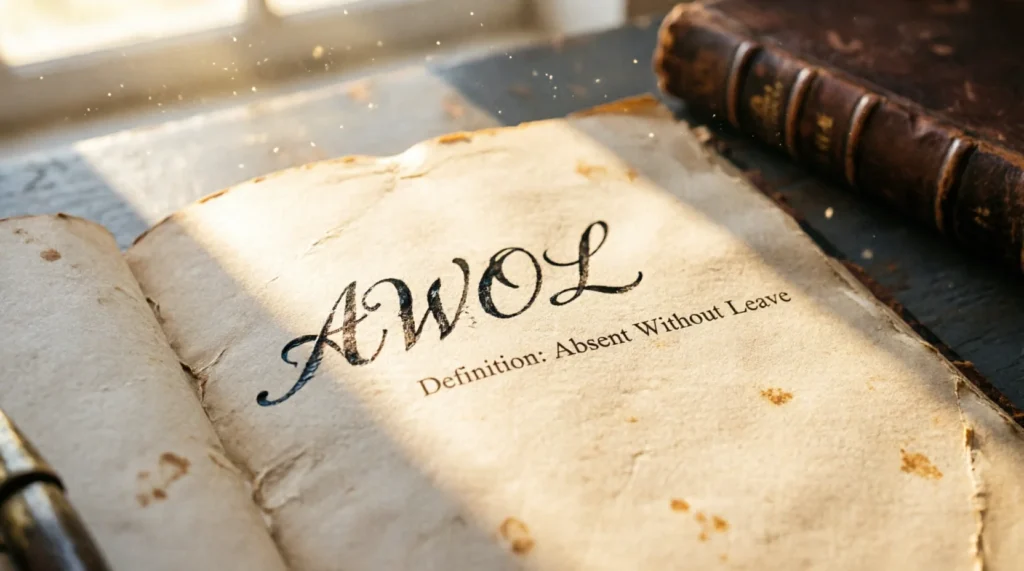
AWOL stands for “Absent Without Official Leave.”
It originally comes from the military and describes a person who leaves their assigned place or fails to report for duty without permission.
Quick Definition
AWOL means being absent or missing without notifying anyone or receiving permission first.
Today, people often use it informally to describe someone who suddenly disappears, stops responding, or becomes unavailable unexpectedly.
🔥 Featured Snippet Definition:
AWOL stands for “Absent Without Official Leave.” It originally referred to military personnel who were absent without permission. Today, it is commonly used to describe anyone who unexpectedly disappears or stops communicating without explanation.
Simple Meaning of AWOL
In everyday language, AWOL simply means:
- Missing unexpectedly
- Not showing up
- Disappearing without notice
- Ignoring communication
- Being unavailable without explanation
Think of it like this:
If your coworker suddenly stops answering emails for several days and nobody knows where they are, someone might say:
“John has gone AWOL.”
It doesn’t necessarily mean anything serious. Often, it’s just a casual way of saying someone vanished temporarily.
Where Is AWOL Used?
The term appears in many different situations today.
1. Military Use
This is the original meaning.
In military organizations, AWOL refers to a service member who is absent from duty without authorization.
Example:
A soldier fails to report to their assigned post without permission.
This is considered a serious matter in military settings.
2. Workplace Conversations
Managers and coworkers sometimes use AWOL informally.
Example:
“The new employee went AWOL after the first week.”
This usually means the person stopped showing up without informing anyone.
3. Social Media
People often use AWOL when someone disappears from online activity.
Example:
“Sorry I’ve been AWOL from Instagram lately.”
Meaning:
The person hasn’t been posting or interacting recently.
4. Group Chats
AWOL is commonly used in messaging apps.
Example:
“You’ve been AWOL all week. Where have you been?”
Meaning:
The person hasn’t responded or participated in conversations.
5. Relationships and Friendships
Friends may jokingly use AWOL when someone disappears.
Example:
“You went AWOL after getting a new boyfriend.”
This implies the person stopped communicating as much as before.
Why Do People Use AWOL?
People use AWOL because it’s a quick and expressive way to describe someone who has disappeared unexpectedly.
Common Reasons Include:
It’s short and memorable
It instantly explains the situation
Many people recognize the phrase It can be serious or humorous depending on context
It works both online and offline
The word often adds a little personality to a conversation compared to simply saying “absent.”
Real-Life Examples of AWOL
Understanding examples makes the meaning much easier to remember.
Example 1: Missing Friend
Friend 1:
“Have you heard from Sarah?”
Friend 2:
“Nope, she’s gone AWOL since last weekend.”
Meaning:
Sarah hasn’t been communicating.
Example 2: Social Media Post
“Sorry for going AWOL these past few weeks. Life has been busy!”
Meaning:
The person has been inactive online.
Example 3: Workplace Situation
“The employee went AWOL and never returned after lunch.”
Meaning:
The employee disappeared without informing anyone.
Example 4: Gaming Community
“Our team captain went AWOL before the tournament.”
Meaning:
The captain became unavailable unexpectedly.
Example 5: Family Conversation
“My brother goes AWOL every time we plan family events.”
Meaning:
He tends to disappear or avoid communication.
AWOL vs Similar Terms
People often confuse AWOL with other words that describe absence.
| Term | Meaning | Typical Use |
|---|---|---|
| AWOL | Missing without notice or permission | Military and everyday conversations |
| Absent | Simply not present | General use |
| Missing | Location unknown | More serious situations |
| Ghosting | Suddenly cutting off communication | Relationships and online communication |
| No-Show | Failing to appear at an event | Work, appointments, meetings |
| MIA | Missing In Action | Military and informal use |
AWOL vs Ghosting
A lot of people mix these up.
AWOL
- Can be temporary
- Doesn’t always involve ending communication permanently
- Often used humorously
Ghosting
- Usually involves intentionally cutting off contact
- Common in dating and friendships
- Suggests a longer-term disappearance
The Origin of AWOL
AWOL has military roots dating back many decades.
The abbreviation became widely used by armed forces to identify personnel who were absent without proper authorization.
Over time, civilians adopted the phrase because it perfectly described everyday situations where someone suddenly vanished from communication or responsibilities.
Today, many people use AWOL without even realizing it originated in military terminology.
When Should You Use AWOL?
You can use AWOL in casual conversations when someone unexpectedly disappears or becomes unavailable.
Good Situations
Friend stops replying
Coworker disappears unexpectedly
Someone becomes inactive online
Team member vanishes from a project
Family member suddenly becomes unreachable
Examples
- “You’ve been AWOL all month.”
- “She went AWOL from social media.”
- “Our teammate has been AWOL lately.”
When Should You Avoid Using AWOL?
There are situations where another term may be more appropriate.
Avoid It When:
Discussing serious missing-person cases
Writing formal legal documents
Describing emergencies without context
Communicating with people unfamiliar with English slang
In these cases, more precise language is usually better.
Common Misunderstandings About AWOL
Many people misunderstand the term.
Misunderstanding #1: AWOL Always Means Military
Not anymore.
Although it originated in the military, modern usage is much broader.
Misunderstanding #2: AWOL Means Someone Is Missing Forever
False.
Most of the time, AWOL simply means temporarily unavailable.
Misunderstanding #3: AWOL Is Always Serious
Not necessarily.
Friends often use it jokingly.
Example:
“You went AWOL after payday!”
This is usually playful rather than serious.
Misunderstanding #4: AWOL and MIA Are the Same
They’re related but different.
AWOL
- Absent without permission
MIA (Missing In Action)
- Status used when someone’s whereabouts are unknown during military operations
The meanings overlap but aren’t identical.
Pro Tips for Using AWOL Correctly
🔥 Understand the Tone
AWOL can sound humorous, casual, or serious depending on context.
🔥 Use It Naturally
Avoid forcing it into every conversation.
🔥 Know Your Audience
Some people may understand the military meaning first.
🔥 Great for Informal Communication
AWOL works best in:
- Text messages
- Social media posts
- Casual conversations
- Online communities
🔥 Pair It With Context
Instead of saying:
“He’s AWOL.”
Say:
“He’s been AWOL from the group chat all week.”
This makes your meaning clearer.
Why AWOL Remains Popular
Language evolves constantly, yet AWOL has remained popular for decades.
Why?
Because everyone has experienced someone disappearing unexpectedly.
Whether it’s a friend, coworker, teammate, or family member, AWOL provides a simple and recognizable way to describe that situation.
Its military origins also give it a strong, memorable impact that ordinary words like “absent” often lack.
FAQs:
What does AWOL stand for?
AWOL stands for Absent Without Official Leave, a military term describing someone absent without permission.
Is AWOL a slang word?
Originally, AWOL was official military terminology. Today, it is commonly used as informal slang to describe someone who unexpectedly disappears or stops communicating.
Is AWOL the same as ghosting?
No. Ghosting usually means intentionally ending communication, while AWOL can simply mean being temporarily absent or unavailable.
Can AWOL be used in everyday conversations?
Yes. People frequently use AWOL in workplaces, friendships, online communities, social media, and casual conversations.
Final Thoughts:
The AWOL meaning is simple once you understand it.
Originally standing for Absent Without Official Leave the term began as military jargon but has become a popular expression in everyday life.
Today, people use AWOL to describe someone who unexpectedly disappears becomes inactive stops responding, or fails to show up without explanation.
Whether you’re talking about a friend missing from a group chat, a coworker who vanished from work, or someone taking an unannounced break from social media, AWOL is a useful and widely understood term.
Use it appropriately understand the context, and you’ll never be confused by it again. ✅

Mira has worked for 5 years as a freelance and online content writer, producing high-quality articles for blogs, websites, and digital platforms. She focuses on delivering original, reader-friendly, and informative content.