

You’re scrolling through Discord TikTok comments roleplay chats or gaming forums and suddenly someone types:
That was so OOC.
Or maybe:
OOC: brb dinner time 😂
At first glance it looks confusing Is it slang A gaming code Some secret internet language
The truth is, OOC has multiple meanings online and understanding it can instantly make you feel more fluent in internet culture.
In this guide you’ll learn exactly what OOC meaning is where people use it how to use it correctly and the biggest mistakes people make with it.
Let’s break it down in the simplest way possible. 👇
What Does OOC Mean?
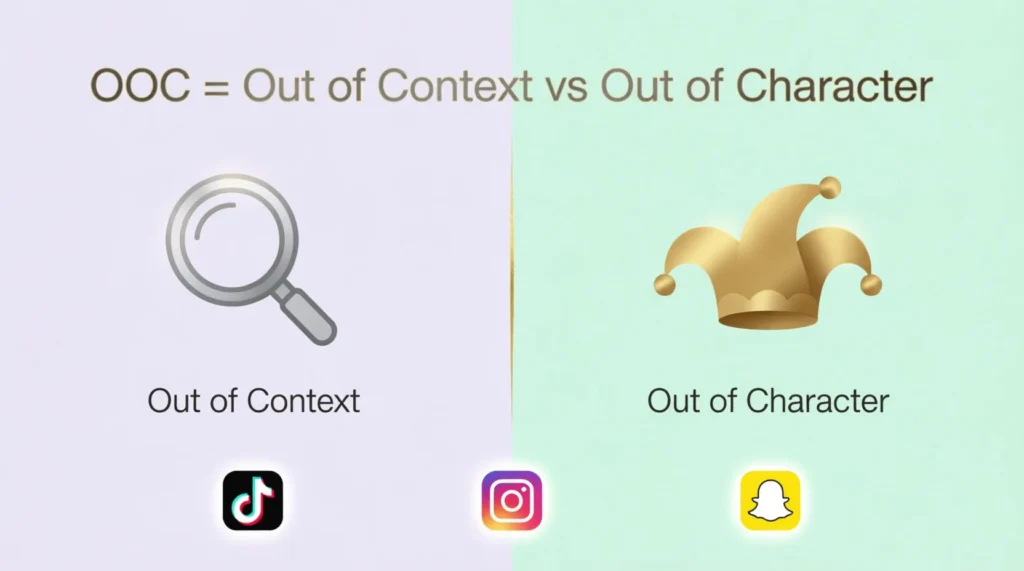
Simple Definition of OOC
OOC stands for:
Out Of Character
It’s mainly used online when someone is speaking or acting in a way that does not match their normal personality, role, or character.
People use it in:
- Roleplay communities
- Gaming chats
- Anime fandoms
- Discord servers
- Fanfiction spaces
- Social media conversations
Sometimes it also means someone is temporarily stepping outside a roleplay conversation to speak normally.
OOC Meaning in Simple Words
Imagine a superhero roleplay chat where someone is pretending to be Batman.
If Batman suddenly says:
“LOL I need coffee before work.”
Another person might respond:
“That’s kinda OOC.”
Why?
Because Batman usually acts serious and mysterious. The message didn’t fit the character.
So basically:
✅ OOC = behavior that feels unusual or unnatural for someone
Where Is OOC Used?
The term became popular in internet culture years ago, especially in fandom and roleplay communities. Today, it’s used almost everywhere online.
Common Places You’ll See OOC
🎮 Gaming Communities
Gamers use OOC during multiplayer roleplay games.
Examples:
- GTA RP
- World of Warcraft
- Roblox roleplay
- VRChat
💬 Discord Servers
Many roleplay Discord servers use “OOC” channels for normal conversations.
Example:
- IC = In Character
- OOC = Out Of Character
📖 Fanfiction Communities
Writers discuss whether fictional characters behave realistically.
Example:
“Harry acting rude to Hermione feels OOC.”
🎭 Roleplay Chats
This is one of the biggest uses of the term.
People often type:
“(OOC: I’ll reply later.)”
to show they’re speaking as themselves instead of the character.
📱 Social Media
Now even casual internet users use OOC jokingly.
Example:
“Seeing my strict teacher dancing on TikTok was so OOC 😂”
Why Do People Use OOC?
People use OOC for several reasons.
1. To Separate Reality From Roleplay
In roleplay communities, people need a way to signal:
“This is me talking — not my character.”
That’s where OOC helps.
Example:
“OOC: Sorry, my internet crashed.”
2. To Point Out Strange Behavior
Sometimes people use OOC when someone acts differently than expected.
Example:
“That angry tweet from him felt really OOC.”
This means the behavior seemed unusual.
3. For Humor and Memes 😂
Internet users often use OOC sarcastically.
Example:
“My cat cuddling me instead of attacking me is OOC.”
It becomes a funny way to describe unexpected behavior.
Real-Life Examples of OOC Meaning
Here are practical examples so you can understand the term naturally.
Example 1: Gaming Roleplay
Player 1:
“The king has ordered everyone to prepare for battle!”
Player 2:
“OOC: Give me 5 mins, food delivery arrived.”
Meaning:
The second player stopped roleplaying and spoke normally.
Example 2: Character Discussion
“Spider-Man being cruel feels OOC.”
Meaning:
That behavior doesn’t match Spider-Man’s personality.
Example 3: Everyday Internet Use
“My introvert friend singing karaoke was so OOC 😂”
Meaning:
The friend acted differently than usual.
OOC vs Similar Internet Terms
Here’s where many people get confused.
| Term | Meaning | Usage |
|---|---|---|
| OOC | Out Of Character | Behavior doesn’t match personality |
| IC | In Character | Staying true to a role/personality |
| RP | Roleplay | Acting as a fictional character |
| AFK | Away From Keyboard | Temporarily inactive |
| IMO | In My Opinion | Sharing personal opinion |
OOC in Roleplay Explained
Roleplay communities use OOC more than anyone else.
IC vs OOC
IC (In Character)
You speak as your fictional character.
Example:
“I shall protect this kingdom!”
OOC (Out Of Character)
You speak as your real self.
Example:
“OOC: I have school tomorrow.”
This distinction helps avoid confusion.
Is OOC Always Negative?
No — and that’s important.
Sometimes “OOC” is neutral.
Example:
“That response felt OOC.”
This simply means something felt unusual.
But other times it can be criticism.
Example:
“The movie made the character act completely OOC.”
Here, someone is criticizing poor writing or unrealistic behavior.
So context matters. ⚠️
When Should You Use OOC?
You should use OOC when:
✅ You’re stepping outside a roleplay
✅ Someone’s behavior feels unusual
✅ Discussing fictional characters
✅ Making funny observations online
✅ Talking in fandom communities
When You Should NOT Use OOC
Avoid using it:
❌ In formal conversations
❌ In professional emails
❌ With people unfamiliar with internet slang
❌ In academic writing
Not everyone understands online shorthand, so use it casually.
Common Misunderstandings About OOC
Mistake #1: Thinking It Means “Offline”
Some people confuse OOC with being inactive.
It does not mean offline.
That’s usually:
- AFK
- BRB
- Offline
OOC specifically relates to behavior or roleplay.
Mistake #2: Using It Only for Fictional Characters
Many think OOC only applies to anime or games.
But people now use it in real-life situations too.
Example:
“My quiet coworker yelling at everyone was OOC.”
Mistake #3: Assuming It’s Always Insulting
Calling something OOC isn’t always criticism.
Sometimes it’s just an observation.
Why OOC Became So Popular Online
The internet loves shorthand expressions.
OOC became popular because it quickly explains:
- Unexpected behavior
- Roleplay transitions
- Personality changes
- Funny situations
It’s short, easy to type, and widely understood in online communities.
That’s why you now see it on:
- TikTok
- Discord
- Twitch chats
- Gaming servers
- Fan communities
Pro Tips for Using OOC Correctly 🔥
✅ Understand the Context
If someone says:
“That was OOC.”
Ask yourself:
- Are they talking about roleplay?
- A fictional character?
- Real-life behavior?
Context changes the meaning.
✅ Use It Casually
OOC is internet slang, so it works best in:
- Casual chats
- Gaming
- Online communities
✅ Don’t Overuse It
Using too much slang can confuse people.
Keep it natural.
✅ Learn Related Terms
Understanding these helps too:
- IC
- RP
- Canon
- Headcanon
- AFK
They’re commonly used together in fandom spaces.
OOC Meaning in Texting
In texting, OOC usually means:
Someone is acting unlike themselves.
Example:
“You’re being really OOC today.”
This could mean:
- unusually emotional
- unusually quiet
- unusually aggressive
- unusually cheerful
It depends on the situation.
OOC Meaning on TikTok and Social Media
On TikTok, people often use OOC humorously.
Examples:
- “Me waking up early is OOC.”
- “Dad using emojis is OOC 😂”
- “My dog being calm for once = OOC”
It’s become part of meme culture.
FAQ About OOC Meaning
What does OOC mean in texting?
In texting, OOC means “Out Of Character.” It describes behavior that feels unusual or unlike someone’s normal personality.
What does OOC mean in roleplay?
In roleplay, OOC means someone is speaking as themselves instead of their fictional character.
Example:
“OOC: I need to leave for dinner.”
Is OOC a bad thing?
Not always. Sometimes it’s criticism, but often it’s just an observation that someone behaved differently than expected.
What is the opposite of OOC?
The opposite is IC, which means In Character.
It describes behavior that matches a character’s normal personality or role.
Final Thoughts:
Internet slang changes fast but OOC has stayed popular because it’s genuinely useful.
At its core the phrase simply means:
Someone is acting differently than expected.
Whether you see it in gaming fandoms Discord chats or memes understanding OOC helps you better understand online conversations and internet culture.
And now the next time someone types:
That feels OOC
you’ll instantly know what they mean. 😄
