
Have you ever been scrolling through social media, reading a text message or browsing online forums when someone suddenly writes OTO? If you paused for a second and wondered what it meant you’re definitely not alone.
Internet slang changes quickly. New abbreviations appear all the time, making online conversations shorter and faster. But some terms, like OTOH have managed to stick around for years because they’re genuinely useful.
So, what exactly does OTOH mean when should you use it and are there situations where it might confuse people? Let’s break it down in the simplest way possible.
What Does OTOH Mean?
OTOH stands for “On The Other Hand.”
It’s an abbreviation people use in digital conversations to present a different viewpoint, contrast an idea, or show another side of a situation.
Featured Snippet Definition:
OTOH means “On The Other Hand.” It’s commonly used in text messages, online discussions, social media posts, and forums when someone wants to introduce an alternative perspective or opposing point.
For example:
“I really want to buy the new phone. OTOH, my current one still works perfectly.”
In this case, the person is considering both sides before making a decision.
Simple Meaning of OTOH
Think of OTOH as a shortcut for saying:
- “However…”
- “At the same time…”
- “Looking at it differently…”
- “There’s another side to this…”
It’s a quick way to acknowledge that situations aren’t always black and white.
Easy Example:
“Working from home saves commuting time. OTOH, it can sometimes feel isolating.”
The speaker recognizes both the positive and negative aspects.
Where Is OTOH Used?
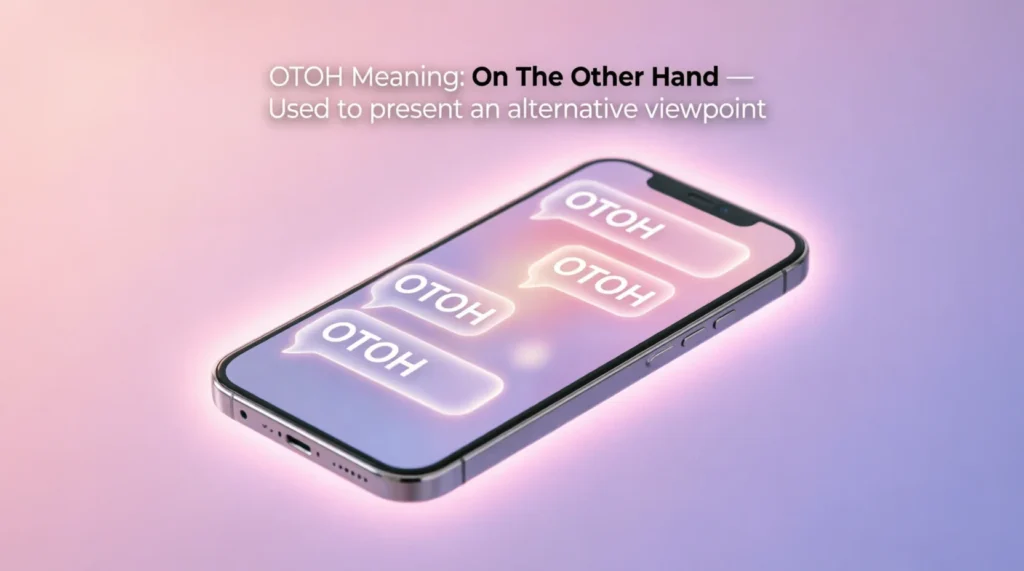
You’ll mostly see OTOH in informal digital communication.
Common places include:
- 📱 Text messages
- 💬 Online chats
- 🐦 Social media platforms
- 👥 Discussion forums
- 📧 Casual emails
- 🎮 Gaming communities
- 📢 Comment sections
While it’s widely understood among many internet users, it’s still considered informal language.
Why Do People Use OTOH?
People love abbreviations because they save time and make typing easier. But OTOH serves a slightly different purpose.
It helps people:
✅ Express balanced opinions
Instead of sounding one-sided, you can show you’ve considered multiple perspectives.
✅ Make conversations concise
Typing “OTOH” is faster than repeatedly writing “on the other hand.”
✅ Sound natural in casual settings
Many online communities use abbreviations as part of everyday communication.
✅ Add nuance to discussions
Life is complicated. OTOH allows you to acknowledge complexity.
For example:
“The apartment is expensive. OTOH, it’s located close to work.”
Real-Life Examples of OTOH Meaning
Understanding internet slang becomes much easier when you see it used naturally.
Example 1: Shopping Decision
“The laptop has amazing performance. OTOH, the battery life isn’t great.”
Meaning: The person likes the performance but recognizes a drawback.
Example 2: Relationship Advice
“You should follow your heart. OTOH, don’t ignore obvious red flags.”
Meaning: Two important viewpoints are being considered.
Example 3: Career Choice
“The new job pays more. OTOH, the commute would be much longer.”
Meaning: Higher salary versus convenience.
Example 4: Entertainment
“The movie had incredible visuals. OTOH, the storyline felt weak.”
Meaning: Positive and negative aspects are both acknowledged.
OTOH vs Similar Internet Terms
Many abbreviations serve different purposes in online communication. Here’s how OTOH compares.
| Term | Full Meaning | Purpose | Example |
|---|---|---|---|
| OTOH | On The Other Hand | Introduce another perspective | “It’s affordable. OTOH, quality may suffer.” |
| IMO | In My Opinion | Share personal views | “IMO, this restaurant is overrated.” |
| TBH | To Be Honest | Express honesty or directness | “TBH, I didn’t enjoy the event.” |
| FWIW | For What It’s Worth | Offer advice or information humbly | “FWIW, I had a similar experience.” |
| BTW | By The Way | Introduce unrelated information | “BTW, are you free tomorrow?” |
The biggest difference is that OTOH specifically signals contrast or an alternative viewpoint.
When Should You Use OTOH?
Knowing when to use OTOH is just as important as knowing what it means.
Use it when:
🔥 You’re discussing pros and cons.
🔥 You’re presenting multiple perspectives.
🔥 You’re chatting casually online.
🔥 You’re participating in forum discussions.
🔥 You’re texting friends or family.
Examples:
“Traveling alone offers freedom. OTOH, sharing experiences with friends can be more memorable.”
“Streaming services are convenient. OTOH, subscription costs can add up.”
When You Should Avoid Using OTOH
Even though internet slang is common, there are situations where writing out the full phrase is a better choice.
Avoid OTOH in:
⚠️ Formal business reports
⚠️ Academic papers
⚠️ Professional proposals
⚠️ Legal documents
⚠️ Communications where clarity is critical
For example, instead of writing:
“OTOH, the data suggests…”
You might write:
“On the other hand, the data suggests…”
Professional writing generally favors clarity over abbreviations.
Common Misunderstandings About OTOH
Because online slang evolves quickly, some people misinterpret abbreviations.
Misunderstanding #1: Everyone knows what OTOH means
Not necessarily.
While frequent internet users may recognize it instantly, others may not.
Misunderstanding #2: It’s appropriate everywhere
OTOH works best in casual settings, not formal communication.
Misunderstanding #3: It’s a new slang term
Actually, OTOH has been around for quite some time and appeared in early internet communities and message boards.
Misunderstanding #4: It’s only for younger generations
People of various age groups use internet abbreviations, especially those active online.
Pro Tips for Using OTOH Correctly
Want to sound natural instead of forcing internet slang into conversations? Keep these tips in mind.
✅ Know your audience
If the person may not understand the abbreviation, spell it out.
✅ Use it sparingly
Too many abbreviations can make messages harder to read.
✅ Maintain context
Make sure you’re actually introducing another perspective.
✅ Match the platform
OTOH fits well on social media and messaging apps but less so in professional environments.
✅ Prioritize clarity
Saving a few keystrokes isn’t worth confusing your reader.
Why Understanding OTOH Matters Today
The internet has changed how people communicate.
Abbreviations like OTOH reflect a broader shift toward faster, more efficient conversations. Understanding these expressions helps you:
- Communicate more effectively online
- Follow discussions without confusion
- Participate confidently in digital communities
- Recognize tone and intent more accurately
Even if you never use OTOH yourself, knowing what it means makes navigating online spaces much easier.
FAQs:
What does OTOH mean in texting?
In texting, OTOH means “On The Other Hand.” It’s used to introduce another perspective or contrast an earlier statement.
Is OTOH considered rude?
No. OTOH is not rude. It’s simply an informal abbreviation used in casual communication.
Can I use OTOH in professional emails?
It’s generally better to avoid OTOH in formal professional communication. Writing out “on the other hand” appears more polished and clear.
Is OTOH still used today?
Yes. While newer slang terms continue to emerge, OTOH remains a recognizable abbreviation in online discussions, forums, and messaging platforms.
Final Thoughts
At its core, OTOH simply means On The Other Hand. It’s a practical abbreviation used to introduce an alternative viewpoint or highlight another side of a situation.
The next time you encounter it in a text message online debate or social media post, you’ll immediately understand what the writer is trying to convey.
Language constantly evolves, especially online. Learning common internet expressions like OTOH helps you stay connected, informed and confident in digital conversations.
And honestly OTOH sometimes spelling out the full phrase is still the better choice. 😉

Mira has worked for 5 years as a freelance and online content writer, producing high-quality articles for blogs, websites, and digital platforms. She focuses on delivering original, reader-friendly, and informative content.