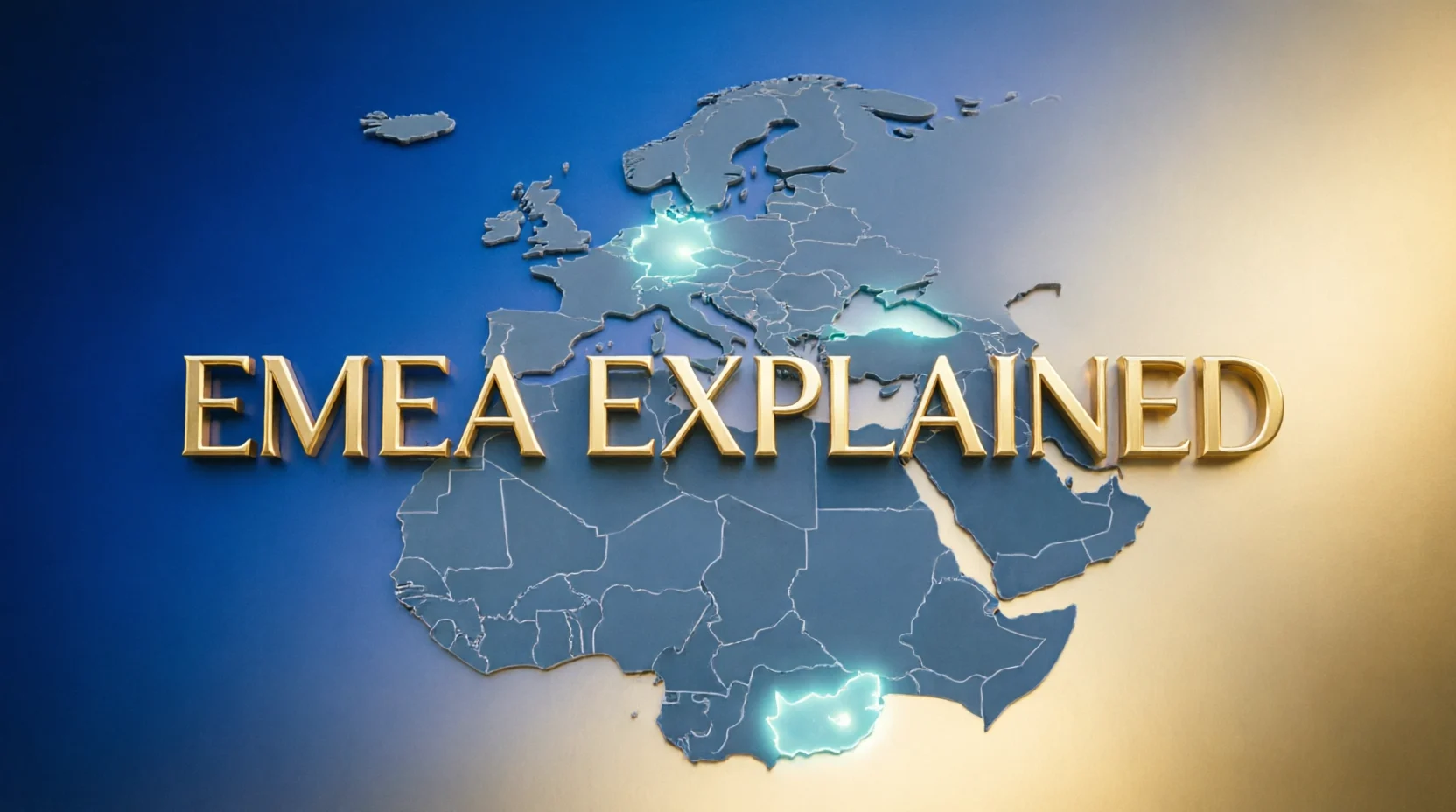
Have you ever come across the term EMEA in a job description business report LinkedIn post or company email and wondered what it actually means?
You’re not alone.
Many people see this abbreviation regularly but aren’t completely sure what it represents. The good news is that the meaning is simple once you understand the context.
In this guide, you’ll learn the EMEA meaning, where it’s used, why businesses rely on it, and how you can understand it like a professional. Let’s dive in. 🚀
What Does EMEA Mean?
EMEA stands for Europe, the Middle East, and Africa.
It is a geographic region used by companies, organizations, and governments to group countries from these three areas into one business market.
Quick Definition
EMEA means Europe, the Middle East, and Africa—a regional classification commonly used by international businesses to organize operations, sales, marketing, customer support, and management activities.
Companies often divide the world into regions to make global operations easier. EMEA is one of the most widely used regional groupings.
Simple Meaning of EMEA
In simple words, EMEA is a shortcut name for a large part of the world that includes countries from Europe, the Middle East, and Africa.
Instead of listing dozens of countries individually, companies simply say “EMEA.”
For example:
- A company may have an EMEA Sales Team
- A business might hire an EMEA Marketing Manager
- Customer support may operate through an EMEA Service Center
- Reports may show EMEA revenue growth
The term helps businesses communicate more efficiently.
Which Countries Are Included in EMEA?

There is no universal list because different organizations may define EMEA slightly differently.
However, EMEA commonly includes:
Europe
- United Kingdom
- Germany
- France
- Spain
- Italy
- Netherlands
- Sweden
- Switzerland
- Poland
Middle East
- United Arab Emirates (UAE)
- Saudi Arabia
- Qatar
- Kuwait
- Bahrain
- Oman
- Israel
- Jordan
Africa
- South Africa
- Egypt
- Nigeria
- Kenya
- Morocco
- Ghana
- Ethiopia
⚠️ Important: Different companies may include or exclude certain countries depending on their business structure.
Where Is EMEA Used?
You’ll mostly see EMEA in professional and business environments.
1. Corporate Organizations
Large international companies often divide operations into regions such as:
- EMEA
- APAC (Asia-Pacific)
- Americas
This helps manage global teams more effectively.
2. Job Titles
Many job listings include EMEA in the title.
Examples:
- EMEA Sales Director
- EMEA Marketing Specialist
- EMEA Operations Manager
- EMEA Regional Manager
In these roles, the employee is responsible for activities across Europe, the Middle East, and Africa.
3. Business Reports
Public companies often report financial performance by region.
Example:
“EMEA revenue increased by 12% this quarter.”
This means revenue generated from Europe, the Middle East, and Africa grew by 12%.
4. Customer Support
Global businesses often organize support centers based on regions.
For example:
“Our EMEA support team is available Monday through Friday.”
This means the support team serves customers located in those regions.
5. Marketing Campaigns
Marketing departments often create regional campaigns.
For example:
“A new EMEA marketing strategy will launch next month.”
The campaign targets customers across Europe, the Middle East, and Africa.
Why Do People Use EMEA?
There are several practical reasons why organizations use this term.
Better Organization ✅
Managing hundreds of countries individually would be difficult.
Grouping them into regions simplifies operations.
Easier Communication ✅
Saying “EMEA” is much faster than listing multiple countries every time.
Regional Strategy ✅
Consumer behavior differs around the world.
Businesses can create region-specific:
- Advertising
- Pricing
- Customer service
- Product launches
Improved Reporting ✅
Companies can analyze performance by region and identify growth opportunities more effectively.
Real-Life Examples of EMEA
Let’s look at some examples you may encounter.
Example 1: Job Advertisement
“We are hiring an EMEA Sales Manager.”
Meaning:
The person will manage sales activities across Europe, the Middle East, and Africa.
Example 2: Company Meeting
“The EMEA team exceeded quarterly targets.”
Meaning:
Employees working within the EMEA region achieved better-than-expected results.
Example 3: Financial Report
“EMEA revenue reached $500 million.”
Meaning:
The company earned $500 million from customers located in Europe, the Middle East, and Africa.
Example 4: Customer Service
“Please contact our EMEA support department.”
Meaning:
A support team dedicated to customers in those regions will assist you.
EMEA vs Similar Regional Terms
Businesses often use several regional abbreviations.
| Term | Meaning | Regions Included |
|---|---|---|
| EMEA | Europe, Middle East, Africa | Europe + Middle East + Africa |
| APAC | Asia-Pacific | Asia and Pacific countries |
| LATAM | Latin America | Central and South America |
| NA | North America | USA, Canada, Mexico |
| AMER | Americas | North and South America |
Understanding these abbreviations helps when reading global business documents.
EMEA vs APAC
People often confuse EMEA with APAC.
EMEA
Includes:
- Europe
- Middle East
- Africa
APAC
Includes:
- China
- Japan
- India
- Australia
- New Zealand
- Singapore
- Other Asia-Pacific nations
If a company has separate EMEA and APAC teams, each team focuses on different markets.
When Should You Use EMEA?
You should use EMEA when discussing:
Business Operations
Example:
“Our EMEA division performed exceptionally well.”
International Teams
Example:
“The EMEA office coordinates regional sales.”
Global Strategy
Example:
“We are expanding our EMEA presence next year.”
Professional Communication
The term is especially useful in:
- Corporate emails
- Business presentations
- Reports
- LinkedIn posts
- Conferences
Common Misunderstandings About EMEA
Many people misunderstand this abbreviation.
Misunderstanding #1: EMEA Is a Country
❌ Wrong
EMEA is not a country.
✅ Correct
It is a regional grouping of many countries.
Misunderstanding #2: Every Company Uses the Same Countries
❌ Wrong
Every organization defines regions slightly differently.
✅ Correct
Country lists can vary depending on business needs.
Misunderstanding #3: EMEA Is Only Used in Europe
❌ Wrong
The term includes Europe, the Middle East, and Africa.
✅ Correct
All three regions are part of EMEA.
Misunderstanding #4: It’s a Government Organization
❌ Wrong
EMEA is not an organization.
✅ Correct
It is simply a geographic business classification.
Pro Tips for Understanding EMEA 🔥
If you’re new to business terminology, keep these tips in mind:
Learn Regional Acronyms
Understanding terms like:
- EMEA
- APAC
- LATAM
- AMER
will make business communication much easier.
Check the Context
Different companies may define regions differently.
Always review company documentation when accuracy matters.
Useful for Job Seekers
If a role contains “EMEA,” expect responsibilities across multiple countries and time zones.
Helpful for International Business
Knowing these regional terms can make meetings, reports, and corporate discussions easier to understand.
Why EMEA Matters in Today’s Global Business World
As companies expand internationally, managing operations across continents becomes more complex.
EMEA provides a practical framework for:
- Managing regional teams
- Tracking performance
- Coordinating marketing
- Supporting customers
- Planning expansion
That’s why you’ll see the term used by multinational corporations, technology companies, consulting firms, financial institutions, and global brands.
The larger a company becomes, the more valuable regional classifications like EMEA become.
FAQs
What does EMEA stand for?
EMEA stands for Europe, the Middle East, and Africa. It is a geographic and business region used by organizations worldwide.
Is EMEA a country?
No. EMEA is not a country. It is a regional grouping that combines Europe, the Middle East, and Africa.
What is the difference between EMEA and the EU?
EMEA is a business region, while the European Union (EU) is a political and economic organization made up of specific European countries.
Why do companies use EMEA?
Companies use EMEA to organize operations, sales, marketing, customer support, and management across multiple countries more efficiently.
Is the United Kingdom part of EMEA?
Yes. Most companies include the United Kingdom within their EMEA region structure.
Final Thoughts
The EMEA meaning is simple: Europe the Middle East and Africa.
While it may sound like complicated corporate jargon it’s really just a convenient way for businesses to group countries into one operational region.
Whether you’re reading a job description reviewing a business report or working for an international company, understanding EMEA can help you communicate more confidently and understand global business discussions more clearly.

Mira has worked for 5 years as a freelance and online content writer, producing high-quality articles for blogs, websites, and digital platforms. She focuses on delivering original, reader-friendly, and informative content.