
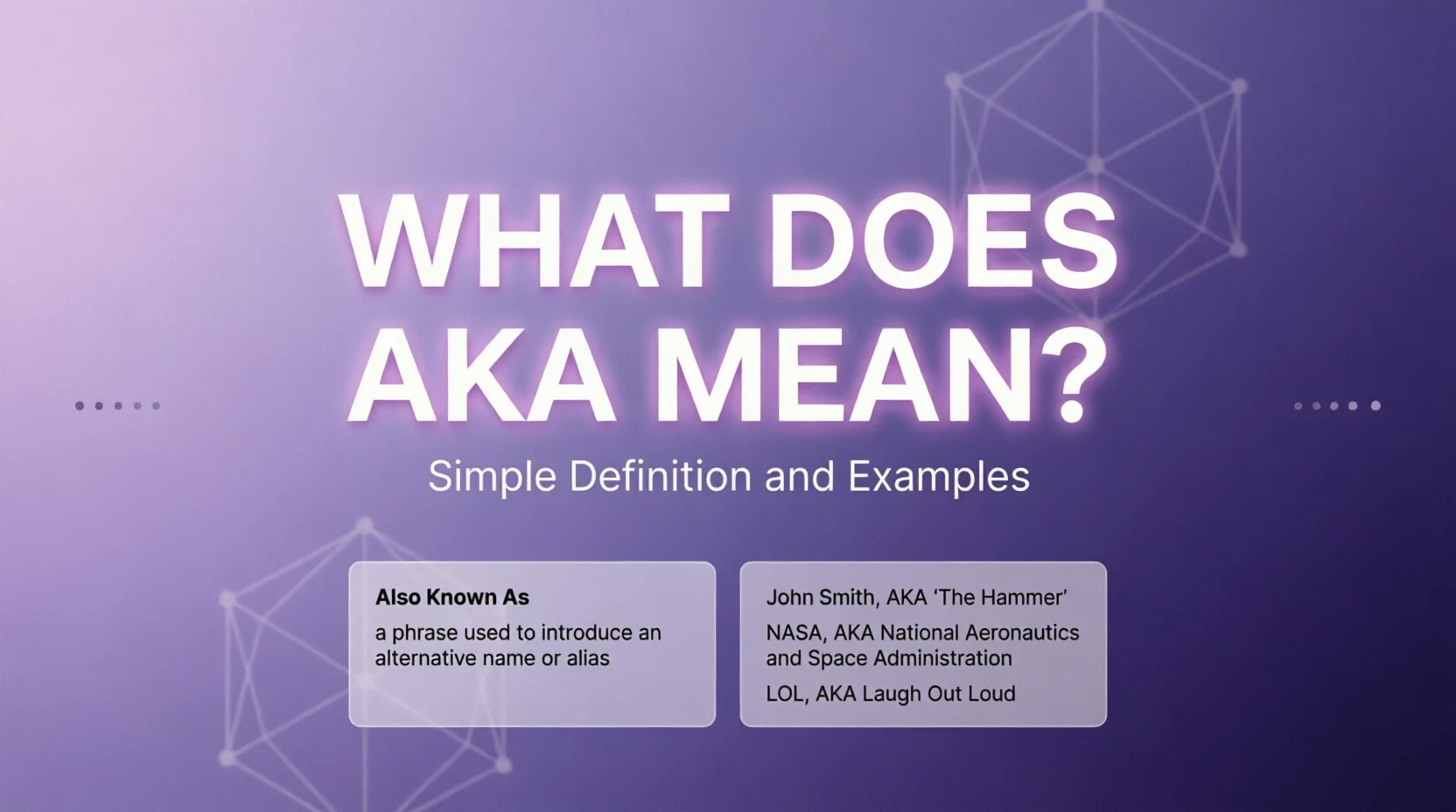
Have you ever seen someone write AKA in a text message social media post or even a news article and wondered what it actually means?
You’re not alone.
This tiny three-letter abbreviation appears everywhere from Instagram bios and memes to celebrity nicknames and professional writing. Yet many people are unsure about its exact meaning and when they should use it.
The good news? It’s incredibly simple.
In this guide you’ll learn what AKA means where it’s used, why people use it and how to use it correctly in everyday conversations.
What Does AKA Mean?
AKA stands for “Also Known As.”
It is used when a person, thing, place, or concept has another name, nickname, title, or identity.
Quick Definition
AKA means “Also Known As,” and it is used to introduce an alternative name, nickname, or identity for someone or something.
Example
- Michael Jordan, AKA “His Airness”
- Clark Kent, AKA Superman
- Robert Downey Jr., AKA Iron Man (to many fans)
In each example, AKA connects a person to another name they are commonly known by.
Simple Meaning of AKA ✅
In simple words, AKA tells people that something has another name.
Think of it like saying:
- “Also called”
- “Known by the name”
- “Better known as”
Easy Example
Imagine your friend is named Alexander, but everyone calls him Alex.
You could say:
Alexander, AKA Alex, is coming to the party tonight.
This helps people understand that Alexander and Alex are the same person.
Where Is AKA Used?
AKA is used in many different situations, both online and offline.
1. Social Media
People often use AKA when introducing nicknames.
Examples:
- Sarah Johnson AKA “The Fitness Queen”
- Daniel AKA “DJ D”
You’ll commonly see this on:
- TikTok
- X (Twitter)
- YouTube
2. Text Messages
Friends use AKA casually when joking around.
Example:
- My brother, AKA the king of sleeping all day, finally woke up.
3. Entertainment Industry
Actors, musicians, and influencers often have stage names.
Examples:
- Marshall Mathers AKA Eminem
- Stefani Germanotta AKA Lady Gaga
4. News and Journalism
Journalists use AKA when referring to aliases or alternative names.
Example:
- The suspect, AKA “Shadow,” was identified by investigators.
5. Professional Writing
Businesses and organizations sometimes use AKA when discussing rebranding or alternative names.
Example:
- Meta, AKA the company formerly known as Facebook.
Why Do People Use AKA? 🤔
People use AKA for several reasons.
To Introduce Nicknames
Instead of explaining a nickname separately, AKA does it instantly.
Example:
- Jennifer AKA Jenny
To Clarify Identity
Some people are known by multiple names.
Example:
- Sean Combs AKA Diddy
To Add Humor
Internet users often use AKA for funny descriptions.
Example:
- Monday AKA the day nobody likes.
To Make Writing Shorter
AKA quickly connects two names without lengthy explanations.
Instead of writing:
“John is also known as Johnny.”
You can simply write:
“John AKA Johnny.”
Real-Life Examples of AKA
Let’s look at practical examples.
Example 1: Celebrity Nickname
Dwayne Johnson AKA The Rock
Explanation:
“The Rock” is the nickname most fans recognize.
Example 2: Friend’s Nickname
Sophia AKA Soph
Explanation:
“Soph” is a shortened version of Sophia’s name.
Example 3: Funny Internet Usage
Coffee AKA my survival fuel.
Explanation:
The writer humorously suggests coffee is essential for getting through the day.
Example 4: Gaming
DragonMaster99 AKA Jake
Explanation:
Jake is the real person behind the gaming username.
Example 5: Business Example
Alphabet Inc. AKA Google’s parent company
Explanation:
AKA helps explain another way the organization is recognized.
AKA vs Similar Terms
Many people confuse AKA with other abbreviations. Here’s a simple comparison.
| Term | Meaning | Usage |
|---|---|---|
| AKA | Also Known As | Alternative name or nickname |
| FYI | For Your Information | Sharing information |
| BTW | By The Way | Adding extra information |
| IDK | I Don’t Know | Expressing uncertainty |
| IMO | In My Opinion | Sharing personal views |
| Alias | Alternative identity | Formal substitute name |
| Nickname | Informal name | Friendly or casual name |
AKA vs Alias
An alias is often used officially or legally.
AKA simply tells readers that another name exists.
Example:
- Samuel Carter AKA Sam
- Samuel Carter used the alias “John Smith”
When Should You Use AKA?
AKA works best when introducing another name or identity.
Use AKA When:
Mentioning nicknames
Referring to stage names
Explaining online usernames
Introducing alternate titles
Adding humorous descriptions
Examples
- Christopher AKA Chris
- Beyoncé AKA Queen Bey
- My dog AKA the house boss
When You Should NOT Use AKA ⚠️
Although AKA is useful, there are situations where it may sound awkward.
Avoid Using AKA:
❌ Between unrelated things
Wrong:
- Pizza AKA football
These are completely different things.
Avoid Overusing It
Using AKA too many times can make writing feel repetitive.
Instead of:
- Tom AKA Tommy AKA T-Man AKA The Legend
Choose the most relevant alternative name.
Formal Documents
Some professional or legal documents may prefer phrases such as:
- Also known as
- Operating under the name
- Doing business as (DBA)
Common Misunderstandings About AKA
Misunderstanding #1
AKA means a secret identity.
Not necessarily.
While AKA can describe aliases, it can also refer to ordinary nicknames.
Misunderstanding #2
AKA is only used online.
False.
AKA has been used in books, newspapers, entertainment, and professional writing for decades.
Misunderstanding #3
AKA is always informal.
Not entirely.
It’s common in casual communication, but it also appears in journalism and informational content.
Misunderstanding #4
AKA only applies to people.
False.
Things, companies, brands, locations, and even ideas can have AKA references.
Example:
- New York City AKA The Big Apple
Pro Tips for Using AKA Like a Pro 🚀
Keep It Relevant
Use AKA only when the alternative name is meaningful.
Know Your Audience
Formal audiences may prefer “also known as” instead of the abbreviation.
Use It for Clarity
The purpose of AKA is to help readers quickly identify someone or something.
Great for Social Media
AKA works especially well in captions, bios, memes, and online posts.
Don’t Force It
If the second name doesn’t add value, skip AKA altogether.
Examples You Can Copy
Here are some ready-to-use examples:
- Emma AKA Em
- James AKA Jimmy
- My laptop AKA my portable office
- Friday AKA everyone’s favorite day
- Chocolate AKA instant happiness
- My cat AKA the ruler of the house
- Sarah AKA the team’s secret weapon
- Coffee AKA morning motivation
FAQs
What does AKA stand for?
AKA stands for “Also Known As.” It is used to introduce an alternative name, nickname, or identity.
Is AKA formal or informal?
AKA is generally informal but can also appear in journalism, entertainment, and informational writing.
Can AKA be used for businesses?
Yes. Businesses, brands, and organizations can be described using AKA when they have another recognized name.
Example:
Meta AKA the company behind Facebook.
How do you write AKA correctly?
You can write it in uppercase as AKA or occasionally in lowercase as aka, though uppercase is more common.
Is AKA the same as a nickname?
Not exactly. A nickname can be introduced using AKA, but AKA itself simply means “also known as.”
Example:
William AKA Bill.
Final Thoughts
So, what does AKA mean?
Simply put, AKA stands for Also Known As. It is used to introduce another name nickname title or identity for a person place thing or idea.
Whether you’re scrolling through social media, reading a news article chatting with friends or creating content online, you’ll encounter AKA frequently.
Once you understand its meaning you’ll notice it everywhere and you’ll know exactly how to use it correctly.

Mira has worked for 5 years as a freelance and online content writer, producing high-quality articles for blogs, websites, and digital platforms. She focuses on delivering original, reader-friendly, and informative content.